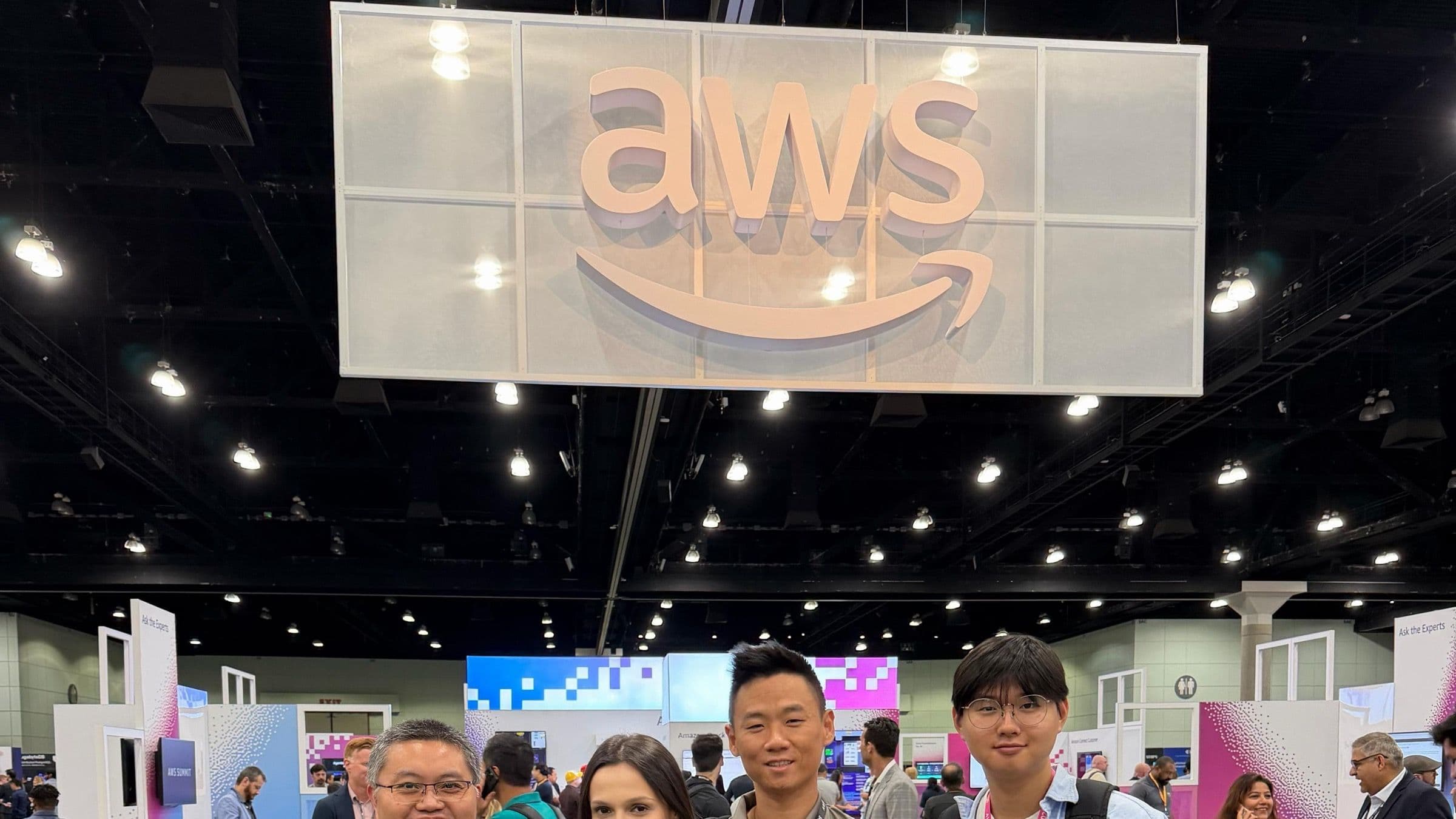
A surrogacy company walks into AWS Summit.
That sounds like the beginning of a joke.
For Patriot Conceptions, it is a strategy.
The natural next chapter after "The Hard Part Is Not Matching" and "AI Is How We Keep the Promise" is not another essay about technology as a spectacle. The first issue argued that the hard part of family building is continuity. The second argued that AI only matters if it helps us keep promises in a high-trust category.
AWS Summit Los Angeles made those two ideas feel like one operating thesis.
Our team recently spent a day at the Los Angeles Convention Center surrounded by developers, cloud architects, AI builders, healthcare technologists, security teams, giant screens, a flower wall, and an expo passport that turned a convention hall full of adults into highly motivated stamp collectors.
At first glance, very little of this looks like surrogacy.
But a family-building journey is one of the most complex coordination problems I know. It crosses intended parents, surrogates, egg donors, fertility clinics, attorneys, insurance reviewers, psychologists, escrow partners, medical records, travel, appointments, medications, state laws, money, and months or years of human emotion.
Every handoff is a chance for context to disappear.
Every delay can become anxiety.
Every unclear owner can become a broken promise.
That is why we were there.
Not because Patriot Conceptions is trying to become a cloud company.
Because we are trying to become a better family-building company.
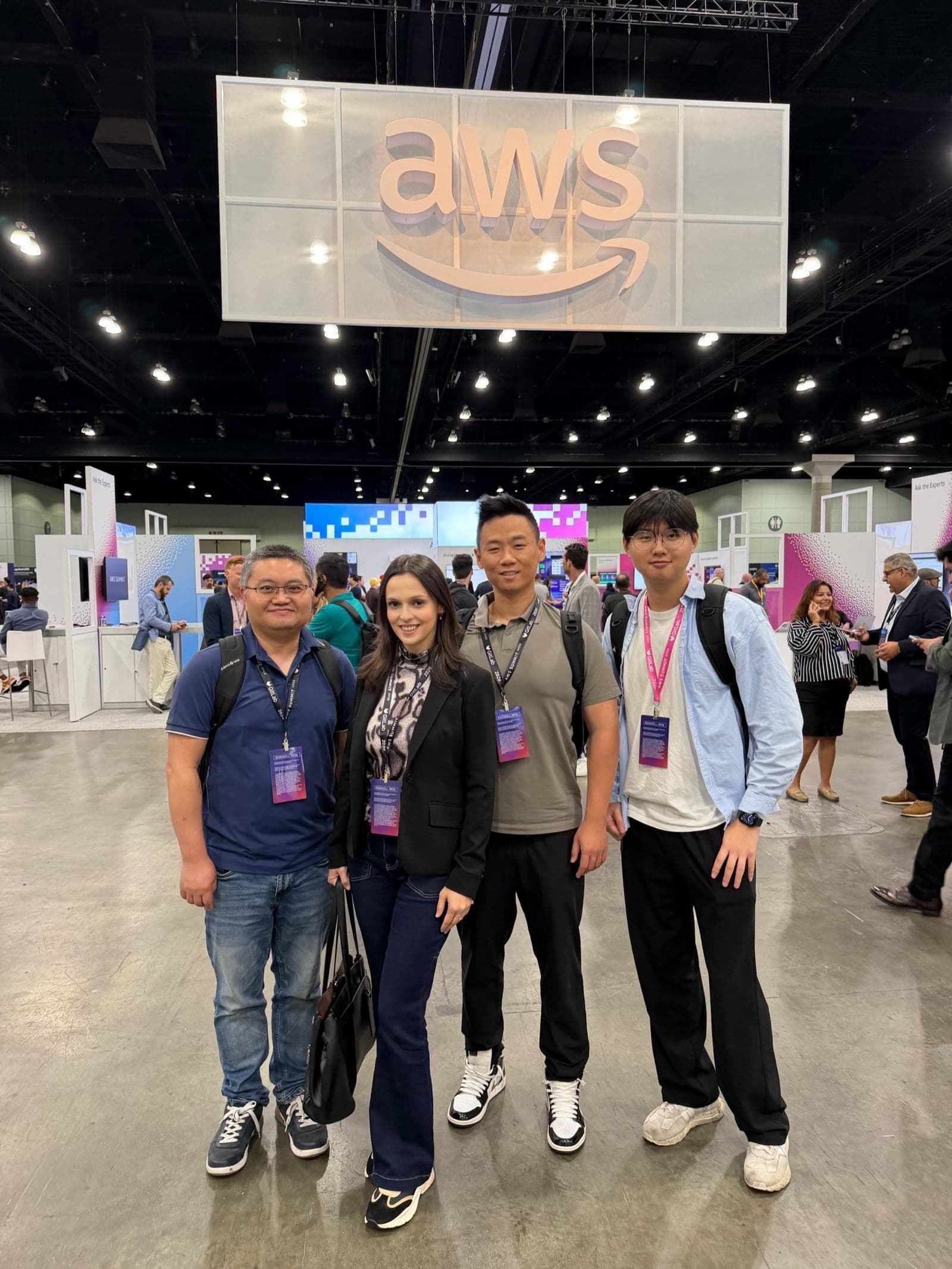
Why This Was Not Random
AWS Summit Los Angeles was not a fertility conference. The official agenda was built around cloud infrastructure, data, security, agentic AI, digital transformation, and developer tooling.
That is exactly why it mattered.
Family building does not fail only because someone lacks empathy. It often fails because the systems around caring people are fragmented. A coordinator becomes the database. A recruiter becomes the reminder engine. A case manager becomes the integration layer. A family becomes the courier between organizations.
That does not scale well.
More importantly, it does not feel good.
The work keeps revealing the same truth: when the system cannot carry context, humans have to compensate with memory, stress, and heroic effort. The best operators can do that for a while. But a company that depends on heroics has not built an operating model. It has built a trap for its best people.
So our software footprint has expanded because the service taught us what the software must understand.
The public website has to educate without overwhelming. The Resource Center and knowledge layer have to make approved information easier to find. The Surrogate Assistant has to help at the front door without pretending to replace a human conversation. The mobile app has to make the next step clearer. The operations portal has to help the team see ownership and stage. The Partner Portal has to support governed handoffs. Journeybook Studio has to preserve memory. TrustUS has to make financial coordination more legible.
Those surfaces look different.
The promise is the same: do not make a family repeat its story every time the journey crosses a system boundary.
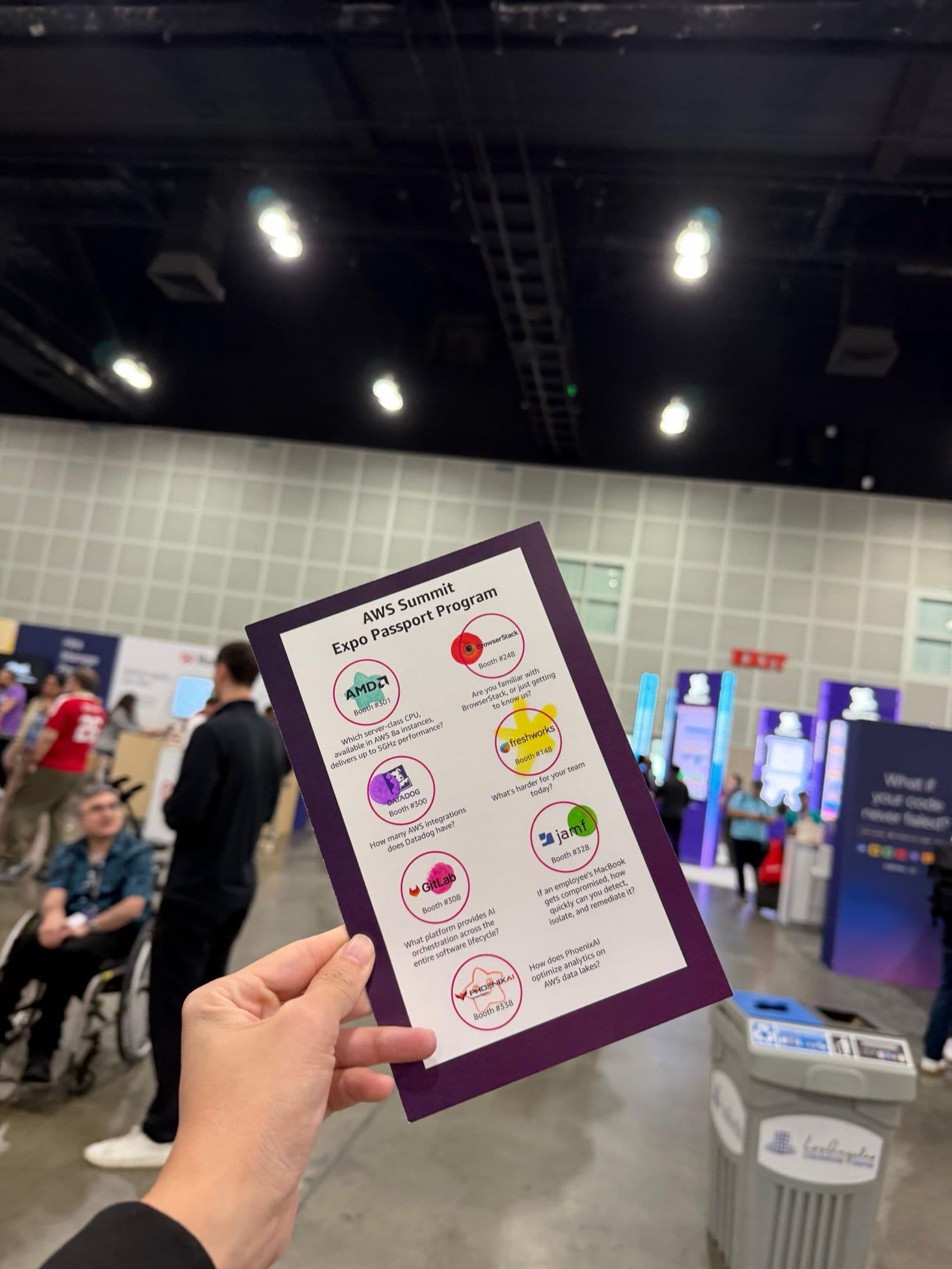
The expo passport was funny because it made sophisticated people behave like children on a scavenger hunt.
It was also a useful metaphor.
Good systems tell you where you are, what is missing, and what comes next. They make progress visible. They turn a confusing floor plan into a path.
That is not so different from what a family-building journey needs.
Agentic Workflow Is A Bad Phrase For A Useful Idea
The technology industry is very good at inventing language that makes normal people want to leave the room.
"Agentic workflow" is one of those phrases.
The idea is much simpler.
Traditional software waits for you to click the next button. A chatbot answers a question. An agentic workflow can understand a goal, gather permitted context, use approved tools, complete several connected steps, and stop for a human when it reaches a decision boundary.
Think of it less like a robot boss and more like a disciplined coordinator with a checklist, a calendar, a map, access to the right folders, and the good judgment to call a supervisor before doing anything sensitive.
In our world, a medical document may arrive by fax, portal, email, upload, or partner handoff. Today, a human may need to open it, identify the person, determine the document type, attach it to the right case, understand what changed, update a task, alert the owner, and explain the next step.
An agentic workflow can carry much of that continuity.
A document arrives.
The system recognizes what it is.
It connects it to the right case.
It checks the current stage.
It prepares the next action.
It alerts the accountable person.
The human reviews, decides, and communicates.
The AI does not become the clinician, attorney, psychologist, or case manager. It becomes connective tissue that helps each of them work with better context.
That distinction matters because healthcare-adjacent work cannot be built on vibes. It needs privacy, permissioning, review paths, auditability, and clear ownership. If an AI system cannot explain where it got its context, what it is allowed to do, and where it must stop, it is not ready for this category.
The goal is not autonomy for its own sake.
The goal is accountable continuity.
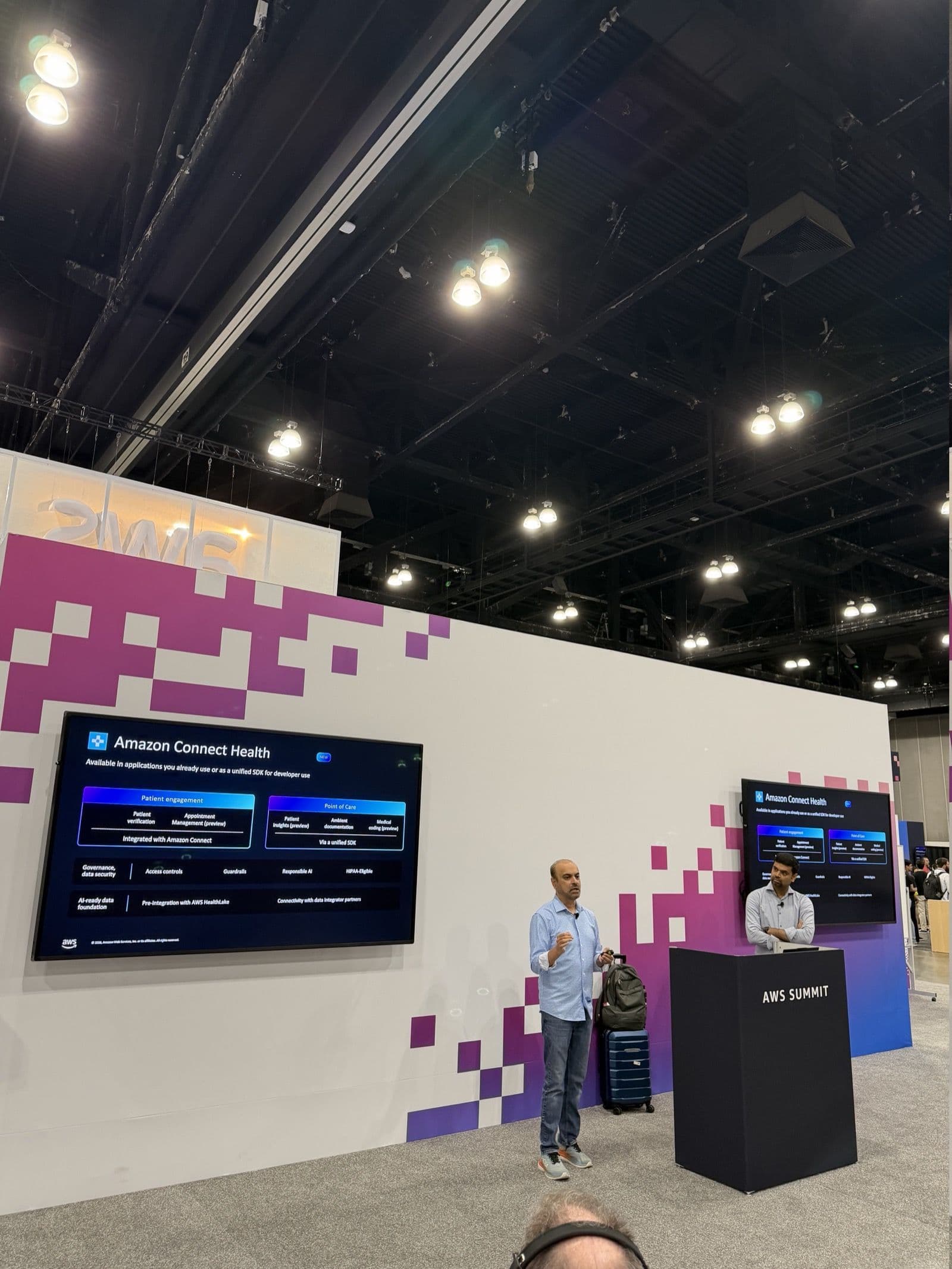
One of the most relevant demonstrations at the summit was Amazon Connect Health. The screen showed patient verification, appointment management, patient insights, ambient documentation, and medical coding connected across patient engagement and point-of-care work.
The useful idea was not "put AI everywhere."
It was: let software carry repetitive coordination while people remain informed, responsible, and in control.
That is exactly the tension we live with in fertility and surrogacy.
The Best AI May Be The AI Nobody Notices
The loudest AI demonstrations usually talk.
The most useful AI often does not.
It notices that a document is missing before the appointment.
It distinguishes a forecast from a clinic-confirmed instruction.
It routes an urgent message before it sits in the wrong queue.
It prepares a case summary before a coordinator makes the call.
It gives a partner the approved context without exposing information they should not see.
It reminds the team that the "simple" scheduling change touches medication timing, travel, work, childcare, and somebody's nervous system.
The best agentic workflow is not the one that looks most autonomous.
It is the one that makes the next responsible action easier.
For a nontechnical audience, that is the whole idea.
An agent is software that can help move work forward.
A good agent knows its tools.
A trustworthy agent knows its boundaries.
A serious organization knows who is accountable when the agent is wrong.
That is why the back office matters so much. It is where trust is won or lost before anyone gives a beautiful speech about care. Did the record arrive? Did the right person see it? Was it assigned? Was the family informed? Was sensitive information protected? Did the next step become clearer?
If AI helps answer those questions earlier, it is not replacing care.
It is protecting care from operational drag.
The Model Is Not The Moat
A few days after the summit, I read Satya Nadella's essay, "A frontier without an ecosystem is not stable."
The line that stayed with me was his distinction between human capital and token capital.
Human capital is the judgment, relationships, creativity, pattern recognition, and domain understanding carried by people.
Token capital is the AI capability a company builds and owns: its agents, workflows, structured knowledge, evaluations, permissions, and accumulated machine-assisted learning.
The phrase may sound technical. The strategic point is very human.
A company should not merely rent intelligence and give away its learning.
It should own the loop in which people teach the system, the system gives people leverage, and every difficult case makes both sides more capable.
Our version of that loop is practical.
When a coordinator solves an unusual insurance problem, the lesson should not disappear inside one inbox.
When a clinic handoff breaks, the root cause should not live only in one person's memory.
When a surrogate asks a question in a way our knowledge base did not anticipate, the system should become clearer.
When an intended parent needs a different explanation, we should learn how to communicate better without turning empathy into a script.
When a partner needs a safer or faster handoff, the workflow should improve for the next family.
That is institutional learning.
The model can change.
The learning loop should compound.
Rent the model. Own the learning loop.
One reason Nadella's framing landed so strongly after an AWS event is that the lesson is larger than any one vendor. We can learn from different clouds, models, frameworks, and developer communities without handing the brain of the company to any single one of them.
The durable asset is not loyalty to a tool.
It is what Patriot Conceptions learns about safely carrying a family-building journey from one human decision to the next.
AI does not make the best coordinators less valuable. It makes their judgment more reusable and frees it from clerical drag.
Multidisciplinary Is Not A Branding Word Here
People often describe themselves as multidisciplinary when they have read two books outside their field.
In surrogacy, multidisciplinary thinking is not a personality trait.
It is the job description.
A match is medical, legal, psychological, financial, geographic, operational, and relational.
A medication reminder is product design, clinical timing, communication, behavioral science, and risk management.
A phone call is customer service, privacy, consent, emotional intelligence, and documentation.
A website page is education, conversion, legal accuracy, accessibility, search, and trust.
A policy change can alter who has access to care, how a benefit is designed, what an attorney must explain, and how a family plans financially.
My own path - civil engineering, Army operations, fertility, public policy, and business - used to look like an unruly resume.
In this work, it has become one toolkit.
Engineering asks whether the system holds.
The Army asks who owns the next action.
Policy asks who gets access.
Business asks whether the model can endure.
Fertility asks whether any of it still feels human to the person living it.
At AWS Summit, moving between AI, healthcare, contact centers, data, security, infrastructure, and developer tooling did not feel scattered.
It felt like looking at the same family-building problem from different floors of the building.
The most interesting companies of the next decade will not be the ones that know the most about one tool.
They will be the ones that can connect disciplines without flattening them.
Why Family Building Needs A Developer Footprint
Patriot Conceptions began as a service company.
But service kept revealing the missing infrastructure.
Fertility technology should not remain an afterthought inside generic healthcare software.
Surrogacy should not be the edge case nobody modeled.
Egg donation should not be a PDF folder with a login screen.
Family building deserves a developer ecosystem of its own.
That does not mean every clinic, agency, attorney, and financial partner has to use one monolithic platform. In fact, that would be the wrong instinct. Families move across organizations. The technology has to respect that.
A developer footprint means building shared language.
It means clearer case stages.
It means consent-aware data contracts.
It means partner APIs when the handoff should be structured.
It means approved knowledge that AI systems can retrieve without guessing.
It means identity, permissions, audit trails, and human review paths.
It means giving young builders real domain problems and teaching them why technical correctness is not enough in a high-trust category.
It also means publishing enough of our product thinking that developers, clinics, attorneys, operators, and partners can challenge it and eventually build with us.
The funny part is that developer ecosystems are not mainly about code.
They are about people agreeing on enough shared language that separate systems can work together.
That is also the work of surrogacy.
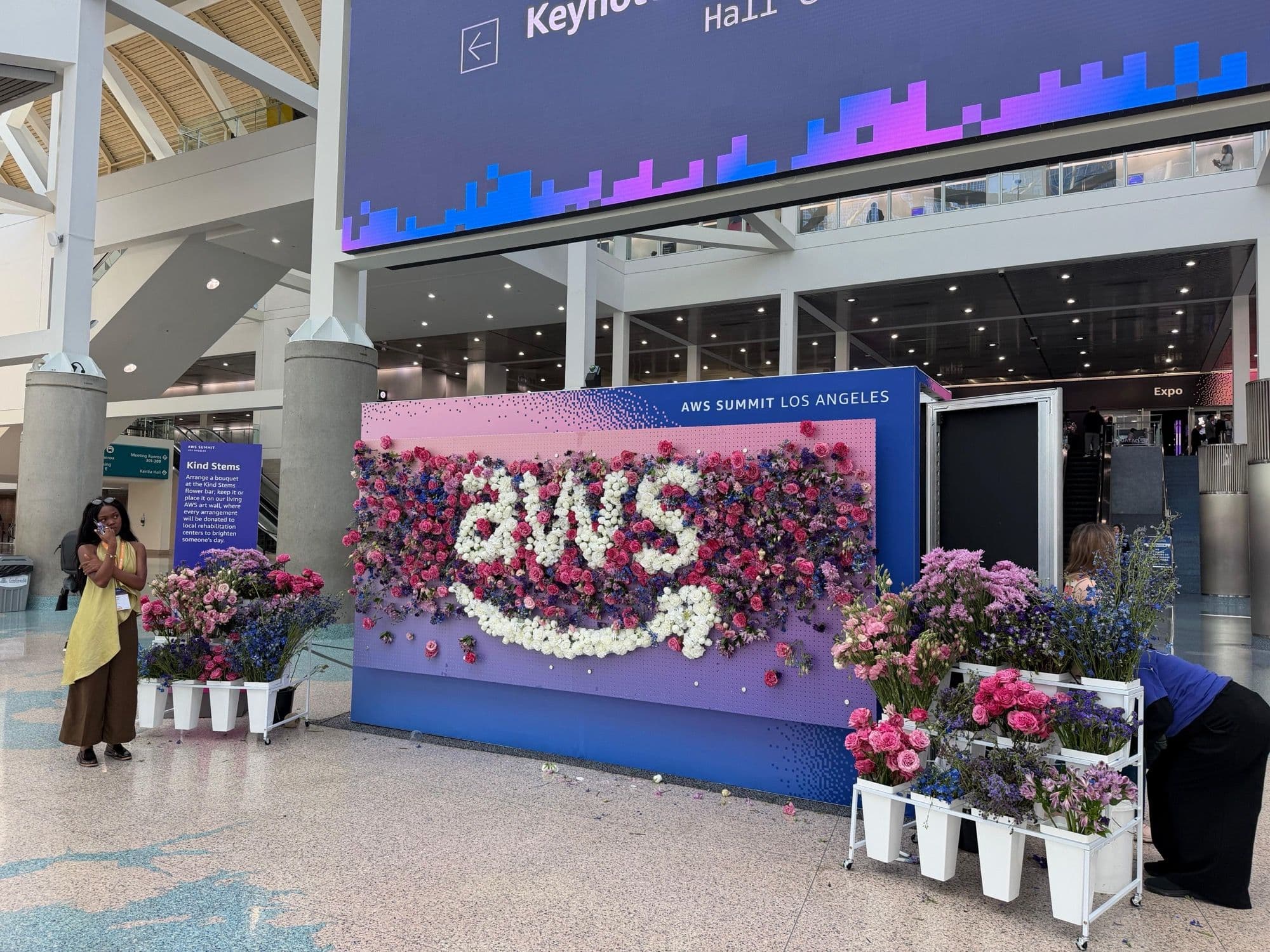
Even cloud infrastructure can make room for flowers.
Good systems should still feel human at the edges.
What We Brought Home
We left AWS Summit with more acronyms than we arrived with.
That appears to be part of the experience.
But the important lessons were simple.
Start with real work, not an AI demonstration. The right question is not, "Where can we add an agent?" It is, "Where are people repeatedly losing time, context, or trust?"
Keep a human at the boundary. AI can prepare, organize, route, summarize, and recommend. Accountable people still decide, especially when the work touches medicine, law, money, privacy, or relationships.
Build memory into the organization. A solved problem should make the next problem easier. Otherwise, the company is using AI without becoming better at learning.
Build an ecosystem, not an island. Families move across clinics, attorneys, insurers, financial partners, and care teams. The technology has to respect that reality.
At a conference built around frontier technology, our clearest conclusion was almost anti-spectacular:
The best AI in fertility may be the AI a family never notices.
The right record arrives.
The right person is alerted.
The next step is clear.
The sensitive information stays protected.
The human has more time to be human.
That is the outcome.
We did not go to AWS Summit to become a cloud company wearing a fertility costume.
We went because family building is too important to run on fragmented memory forever.
The future of family building will not be won by the agency with the loudest chatbot or the most impressive model.
It will be won by teams that combine human judgment with systems that remember, coordinate, and learn.
That is the loop we are building.
And yes, the expo passport worked.
Apparently, even the frontier runs on stamps.
What part of your organization still depends on one person remembering everything?
That is probably where your first agentic workflow is hiding.
Get the next one in your inbox.
Subscribe for new issues. Unsubscribe anytime.
One email. No spam. Unsubscribe anytime.
Privacy policy