I have learned to accept many things as a UCLA person.
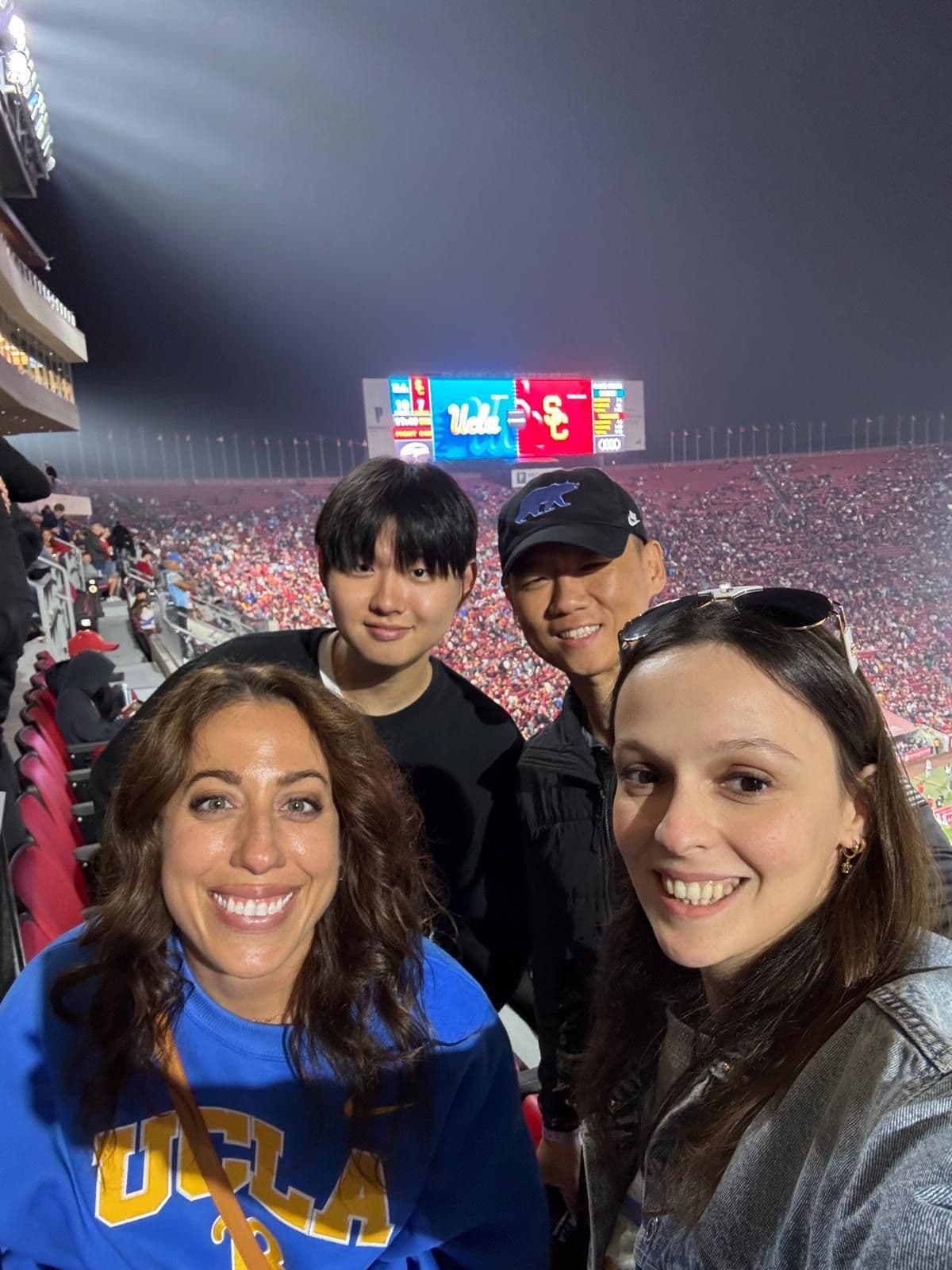
Traffic on the 405. Explaining that Westwood is not "basically Santa Monica." The emotional volatility of college football. And, most recently, sitting in club seats at the Coliseum while a USC computer science student on our team waved and laughed at his friends in the student section after my school got beat.
That last one required some growth.
The setting was the Victory Bell game, which is already designed to make otherwise reasonable people act like the future of civilization depends on a fourth-down conversion. The stadium was red. The scoreboard was rude. The UCLA sweatshirt in our group was brave. And Justin, a senior in Computer Science at USC, was having a very good time.
I could have chosen bitterness.
Instead, I chose the only mature response available to a founder: I reminded myself that competition is fun, but collaboration builds.
The Rivalry Is The Joke. The Work Is The Point.
Justin joined Patriot Conceptions last spring.
He was selected from almost 400 applicants. The hiring process was not a resume beauty contest. We gave candidates a practical test: rebuild the Stripe Press experience, with the kind of animation, polish, layout discipline, and user-experience sensitivity that exposes whether someone can actually work through a complex interface.
That test was intentionally difficult.
It was not difficult because we needed an intern to copy a website. It was difficult because modern product work is no longer only about knowing a framework, passing an algorithm screen, or naming the right design pattern. The work now asks a different question: can you learn fast, reason through ambiguity, use tools without being used by them, and keep quality high when the surface area is moving?
Justin passed that test in a moment when the computer science job market was, to put it gently, screaming.
Students were watching internships disappear. New graduates were watching entry-level roles become oddly senior. Companies were announcing AI productivity gains while also raising the bar for junior hiring. At the same time, the first wave of agentic coding tools was arriving: Cursor, Windsurf, and a new category of tools that did not just autocomplete a line, but could help a builder reason across a codebase.
Many schools were still unsure what to do with that.
Some treated AI as a threat to academic purity. Some treated it as cheating until the policy memo could catch up with reality. Some students learned to hide their tool use instead of learning how to use it responsibly.
At Patriot Conceptions, we made a different choice.
From day one, Justin learned with the tools on the table.
Not because AI was magic. Not because judgment could be outsourced. But because the future of software work was clearly changing, and it felt dishonest to train young builders for yesterday's workplace while tomorrow's workplace was already walking through the door.
Give Young Talent Real Work Earlier
During his first summer internship, Justin recreated the Patriot Conceptions website.
That sentence sounds simple until you understand what the work required.
The old site had to become clearer, faster, more trustworthy, and easier for real people to navigate. Intended parents should not have to fight a website to understand a surrogacy journey. A potential surrogate should not feel like she has landed in a brochure from another decade. A clinic, attorney, veteran-family partner, or fertility professional should be able to understand who we are, what we do, and why our operating standard is different.
Justin worked through that challenge with Astro and Cloudflare, but the important part is not the brand names of the tools.
The important part is what changed for the reader.
Pages loaded faster. The structure made more sense. The visual language felt more current. The site became easier for search engines to understand and easier for humans to trust. The work took something that had been functional and made it feel more like the company we were becoming.
That is what good technical work does.
It does not show off. It reduces friction. It makes the next action clearer. It makes the organization more legible.
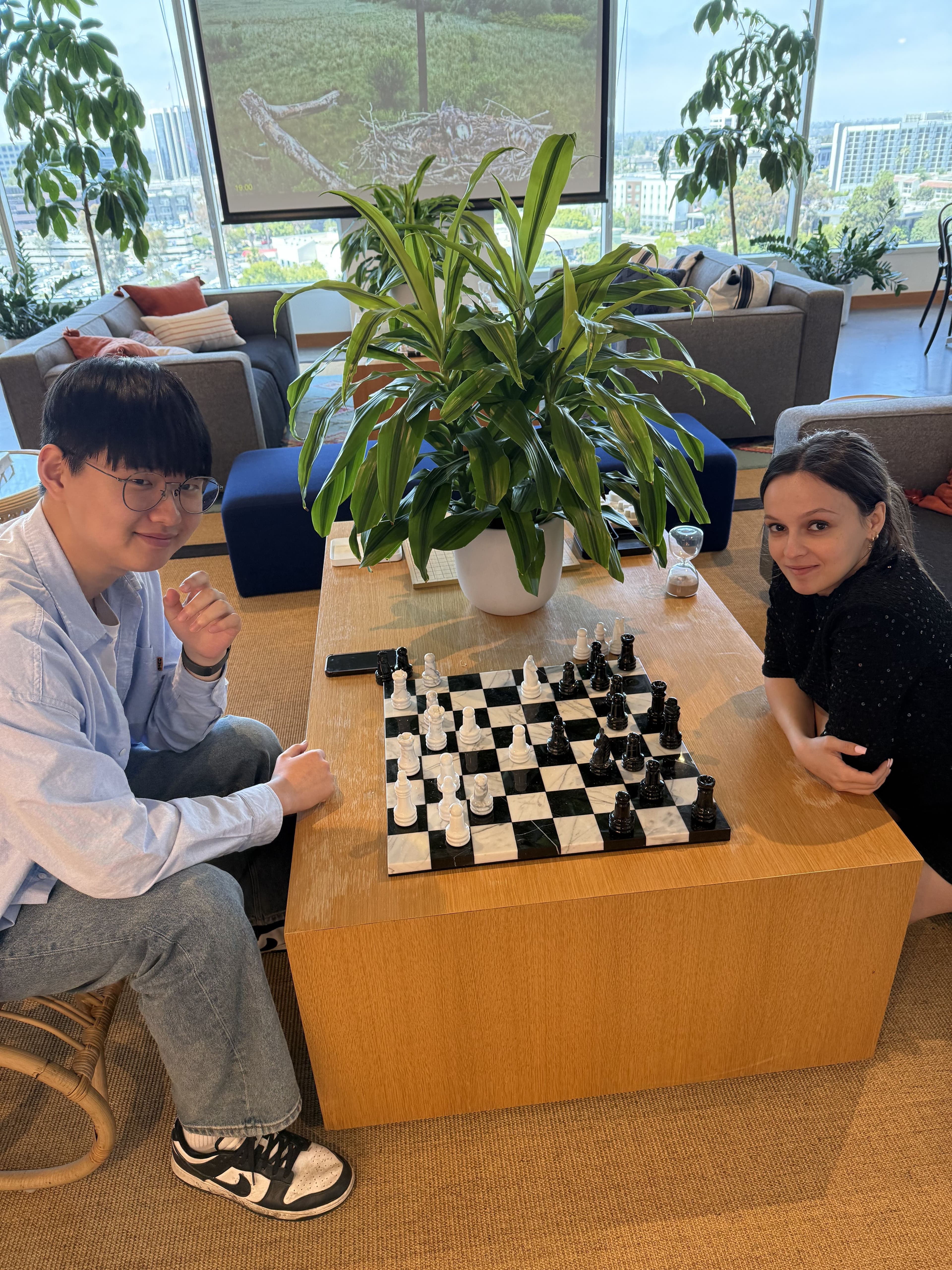
The chess photo from that summer is one of my favorite images of the team.
It is not a staged recruiting photo. It is just a bright office, a board mid-game, a colleague across the table, and the quiet concentration of people learning how each other thinks.
That is the part of internships that is easy to underestimate.
You are not only hiring output. You are creating an apprenticeship environment. The intern is learning the company, but the company is also learning how to teach. If you give a young person only tiny tasks, you learn very little about them. If you give them real responsibility with real support, you learn how they think, how they recover, how they ask questions, how they handle feedback, and whether they can become dangerous in the best possible way.
AI Did Not Replace The Intern. It Raised The Ceiling.
Justin joined when the tool landscape was changing almost weekly.
He learned Cursor and Windsurf early. Then Claude Code and Codex arrived, and he switched quickly. That adaptability mattered. Not because every new tool deserves loyalty, but because builders now need a habit of evaluation: What does this tool make easier? Where does it hallucinate confidence? What work still requires human taste? What should never be delegated?
That is the educational point I keep coming back to.
AI-native work does not mean telling a model to build the company while everyone watches. It means a young builder can move across a much larger surface area if the team teaches them how to think clearly, test carefully, and keep ownership.
Justin did not become useful because AI wrote code for him.
He became useful because he used AI to ask better questions, move faster through the boring parts, compare approaches, explore unfamiliar files, and keep iterating until the work was no longer just technically correct but productively useful.
That distinction matters.
The market is currently confused about young talent. Some companies look at AI and conclude they need fewer junior people. I think that is too shallow. The better question is whether we are willing to train junior people differently.
If the old junior role was "wait until someone gives you a ticket and then implement the obvious part," AI will compress that job.
But if the new junior role is "learn the domain, use tools responsibly, test assumptions, ship narrow improvements, absorb taste, and grow into a high-context operator," then investing early becomes even more important.
You are not buying labor.
You are growing judgment.
The Second Summer Started Fast
Justin just started his second summer internship at Patriot Conceptions.
He is now a senior at USC. He has built independent mobile apps, including JourneyBooks. He has kept learning as the tools changed. And almost immediately after returning, he began revamping the Patriot Conceptions mobile app.
That is what continuity makes possible.
The first summer was not a one-off internship project that disappeared into a folder. It became shared context. He came back understanding our users, our taste, our operational needs, and the seriousness of building in fertility and surrogacy. He did not need to start from zero. He could start from trust.
That is why early investment compounds.
A company that only hires people when they are fully formed will always pay the market price for finished judgment. A company that can identify promise early, give it real work, and stay close enough to coach it, gets to participate in the formation of judgment.
There is risk in that. Young people make mistakes. So do senior people, usually with more expensive titles. The difference is whether the company has enough discipline to make mistakes survivable and enough generosity to make learning real.
For a healthcare-adjacent company like ours, that does not mean handing sensitive work to someone without structure. It means building privacy-aware systems, review paths, test environments, and clear ownership so young builders can contribute without pretending the stakes are low.
The work is serious.
That is why the training should be serious too.
What I Want More Founders To Try
I want more founders to invest in young talent before the market has fully priced them.
Not as charity.
As strategy.
Find the person who is curious enough to learn a new tool before it is fashionable, humble enough to accept review, stubborn enough to polish the last 10 percent, and honest enough to say, "I do not know yet."
Then give them a real problem.
Not the fake intern project. Not the decorative dashboard. Not the busywork nobody wanted to do.
Give them a piece of the company that matters, with guardrails, feedback, and a standard high enough to be respectful.
That is how people grow. It is also how companies stay alive.
Because the real competition is not USC versus UCLA. It is not Cursor versus Windsurf, Claude Code versus Codex, or one framework versus another. Those rivalries can be fun. They give us jokes, school colors, and the occasional painful football memory.
The real competition is between organizations that learn and organizations that defend old habits until the world moves on without them.
On that field, collaboration wins.
Even when the USC kid gets to laugh at the UCLA founder from club seats at the Coliseum.
I am still recovering from that part.
But I would hire the Trojan again.
Get the next one in your inbox.
Subscribe for new issues. Unsubscribe anytime.
One email. No spam. Unsubscribe anytime.
Privacy policy