
The first image in this issue is a real room.
At a roundtable discussion on the future of surrogacy operations, Patriot Conceptions hosted a conversation about AI, automation, and real-time matching. That is where I want this story to begin: not with a speculative technology demo, but with people in the field asking how this industry should actually work.
AI is only useful here if it can survive contact with the room: clinicians, coordinators, intended parents, surrogates, donors, attorneys, escrow partners, and operators who live with the consequences of every unclear handoff.
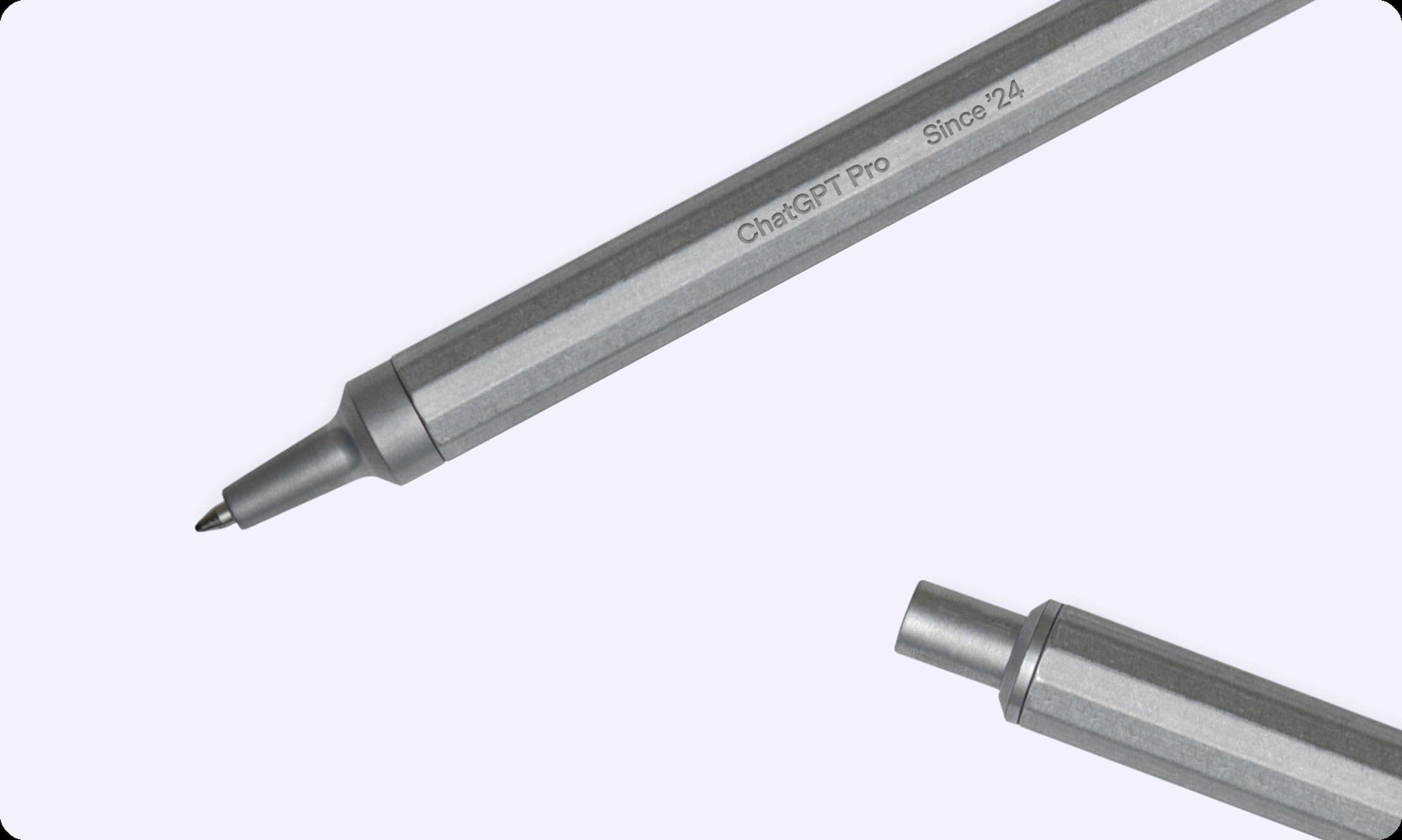
There is another image that belongs near the beginning: a pen.
When OpenAI sent the ChatGPT Pro "Since '24" pen to its earliest subscribers, it was a small physical signal from a company building at the frontier. For Patriot Conceptions, it also became a useful reminder. We have not treated AI as a trend to watch from a safe distance. We have tried to stand near the frontier, use the tools early, test them under real operating pressure, and ask a harder question than whether the technology is impressive.
The question is: can it help us keep our promises?
In fertility and surrogacy, the promise is not abstract. Intended parents need clarity when the path is uncertain. Surrogates deserve respect, structure, and timely communication. Donors, clinics, attorneys, coordinators, escrow partners, and nurses all need context that does not disappear between handoffs. Families need people who can move fast without becoming careless.
That is the reason AI matters to us. Not because it looks futuristic. Because the work is too human to leave buried inside fragmented inboxes, PDF attachments, isolated spreadsheets, missed calls, and memory.

From Tool Use To Operating Discipline
There is a difference between using AI and becoming AI-native.
Using AI means asking a model to draft a sentence, summarize a document, generate an image, or answer a question. Those are useful acts. They save time. They expand the surface area of a small team.
Becoming AI-native is different. It means redesigning the way the company thinks, routes, records, escalates, checks, and learns. It means the technology is not a sidecar. It becomes part of the operating discipline.
That shift has been the real work at Patriot Conceptions.
We use AI to think faster, but the goal is not speed alone. We use it to make context durable. We use it to reduce ambiguity before it becomes anxiety. We use it to help the team see the next decision, the current risk, and the missing piece of information. We use it to make operations more legible, so a family-building journey does not depend on one heroic coordinator remembering every thread by hand.
Healthcare-adjacent work cannot be built on vibes. It needs privacy, judgment, boundaries, auditability, and human ownership. AI that cannot respect those constraints is not ready for this category.
So our approach is simple: frontier tools, disciplined use, human accountability.
The Interface Is A Promise
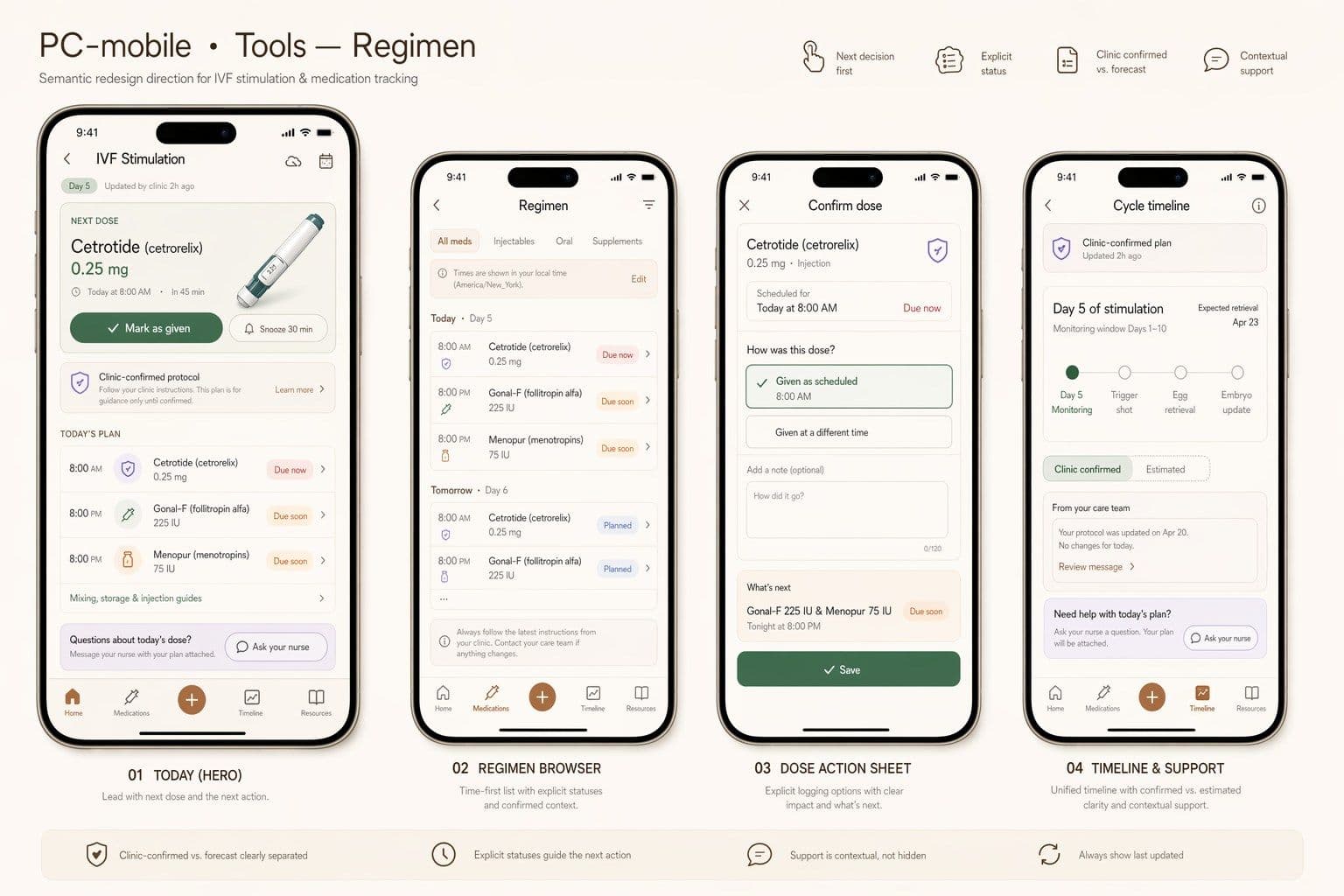
Our IVF stimulation and medication-tracking direction looks like a mobile interface, but what it really represents is a principle: the next decision should be clear.
Family-building care often gives people too many fragments. A portal message here. A medication label there. A PDF instruction sheet. A phone call. A clinic note. A calendar invite. A nurse's clarification. A changed dosage. A monitoring visit. A trigger shot window. A retrieval estimate. Each piece may be correct, but the lived experience can still feel chaotic.
The design direction we are pushing toward separates what is clinic-confirmed from what is estimated. It shows the next dose before the long list. It makes status explicit. It gives the user a contextual support path, not a generic help button floating somewhere else.
That is AI work even before a model appears on screen.
Good AI products are not just smarter chat boxes. They are systems that decide what should be visible, what should be hidden, what should be confirmed, what should be escalated, and what should never be guessed.
Matching Needs More Than A Profile Card
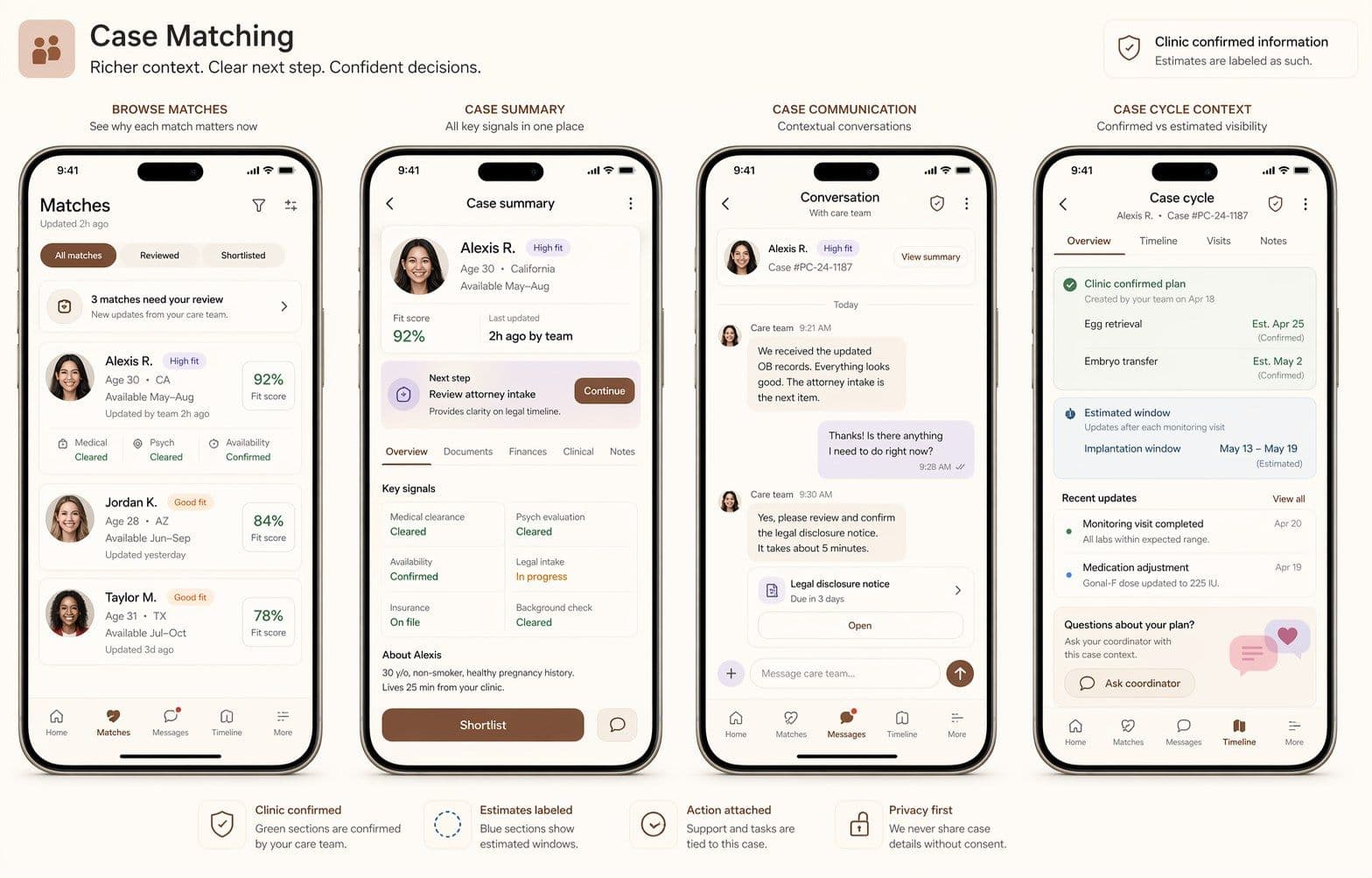
The same standard applies to case matching.
That is one of the most important areas where the surrogacy and donor world needs a higher standard. Matching is too often presented as a browse-and-select experience, as if the most important work is choosing from a catalog. But the actual decision is much more serious.
An intended parent is not only asking, "Do I like this profile?"
They are asking whether the journey can be safe, aligned, legally sound, clinically workable, emotionally sustainable, financially clear, and properly supported by a team that sees the whole case.
That requires richer context: medical clearance, psychological readiness, insurance, availability, attorney intake, clinic timing, state-law considerations, communication preferences, open questions, non-negotiables, and changes since last review.
This is where AI can be transformative if it is used with discipline. It can surface signals. It can flag missing information. It can help a coordinator prepare a better explanation. It can compare cases against explicit criteria. It can show why a match is ready, why it is not ready, or why it needs human review.
But AI should not pretend to be the moral decision-maker.
The goal is not to remove judgment. The goal is to give judgment better context.
The Back Office Is Where Trust Is Won
The most visible AI demos usually happen at the front end. A chatbot. A shiny assistant. A generated image. A beautiful product surface.
But in our business, trust is often won in the back office.
Did the fax get received? Was it assigned to the right person? Did someone know it was urgent? Was the record attached to the right case? Did the team see the new document before the next decision? Did the family get an answer before anxiety filled the silence?
That is why the PC Ops Notifier image is deliberately privacy-safe. The point is not operational detail. The point is the operating pattern.
AI should help route work before it becomes a crisis. It should help classify inbound documents, alert the right team member, and keep the case moving without forcing people to babysit every queue. It should make the invisible work visible enough to manage.
The industry often talks about AI as if it will replace care. I think that is the wrong frame.
At Patriot Conceptions, the better use of AI is to protect care from operational drag.
What Should Shock The Industry
The AI-generated image in this issue is aspirational on purpose.
It imagines a future where fertility and surrogacy operations are not scattered across disconnected tools, but coordinated through a privacy-first command layer. Intake, clinic records, medication timing, legal milestones, case matching, fax triage, escrow, insurance, and care-team communication should not feel like separate worlds to the people living the journey.
What should shock the industry is not a more theatrical image of technology.
What should shock the industry is a higher operating expectation.
Every family should know what is happening next. Every surrogate should know who is responsible. Every coordinator should have the context needed to make a better decision. Every clinic update should land where it belongs. Every estimate should be labeled as an estimate. Every confirmed instruction should be clearly distinguished from a forecast. Every sensitive record should be treated as sensitive. Every AI-generated output should have a human owner.
That is the standard.
If that sounds ambitious, it should. This field deserves ambition.
Bringing The Conversation Into The Room
The roundtable photo matters because it shows the other half of the work.
We are not building this in isolation. We are bringing the conversation into the rooms where surrogacy professionals, clinic operators, lawyers, coordinators, and intended-parent advocates are already asking what the next operating model should be.
The sign on the table says the conversation was powered by Patriot Conceptions. The topic was the future of surrogacy operations: AI, automation, and real-time matching.
That is exactly where I want us to keep pressing.
Not AI as theater. AI as better care infrastructure.
Not automation as cold efficiency. Automation as fewer dropped handoffs, fewer status mysteries, fewer preventable delays, and more time for humans to do the work that actually requires humanity.
Not matching as a marketplace. Matching as a high-context decision system.
Not a company trying to sound futuristic. A company trying to make family-building less chaotic for the people brave enough to enter it.
Why We Lead From The Frontier
I do not want Patriot Conceptions to adopt AI late because the industry finally decides it is safe to talk about.
I also do not want us to adopt AI recklessly because the technology is exciting.
The position I believe in is harder: lead early, build carefully, and let the operating reality teach us what is actually useful.
That is why the ChatGPT Pro gift belongs at the beginning of this issue. It is a symbol of early adoption, but it is also a reminder that tools are only tools. The frontier is not valuable because it is new. It is valuable when it helps us become more accountable to the people we serve.
For Patriot Conceptions, AI is not a replacement for trust.
AI is how we make trust easier to keep.
That is the company we are building: privacy-first, human-owned, AI-native, and serious enough to bring frontier technology into one of the most personal journeys a family can take.
Get the next one in your inbox.
Subscribe for new issues. Unsubscribe anytime.
One email. No spam. Unsubscribe anytime.
Privacy policy