Everyone says "build a surrogate marketplace."
I understand why.
Marketplaces are one of the clearest company-building ideas of the internet era. There is supply. There is demand. There is information asymmetry. There is friction. Build the platform, improve discovery, standardize the transaction, and the market gets more efficient.
That framing works in many categories.
But in family formation, I think it is already too small.
The hard part is not matching.
The hard part is continuity.
A surrogacy or egg donation journey is not one transaction. It is a long, emotional, regulated, multi-party project. It crosses intended parents, surrogates, egg donors, recruiters, coordinators, clinics, attorneys, insurance, finance, medical records, and support.
Every boundary is a chance for context to disappear.
- Who owns the next action?
- What consent applies?
- Which record is missing?
- What stage is the case in?
- What did the clinic ask for?
- What did the intended parents already hear?
- What is sensitive and should not be shared?
- What changed since the last conversation?
In most high-trust service categories, the answer to those questions lives in people.
A coordinator remembers. A recruiter follows up. A case manager checks the spreadsheet. A staff member finds the fax. A partner emails a PDF. A human carries the work forward.
That human work is noble.
It is also fragile infrastructure.
The continuity layer
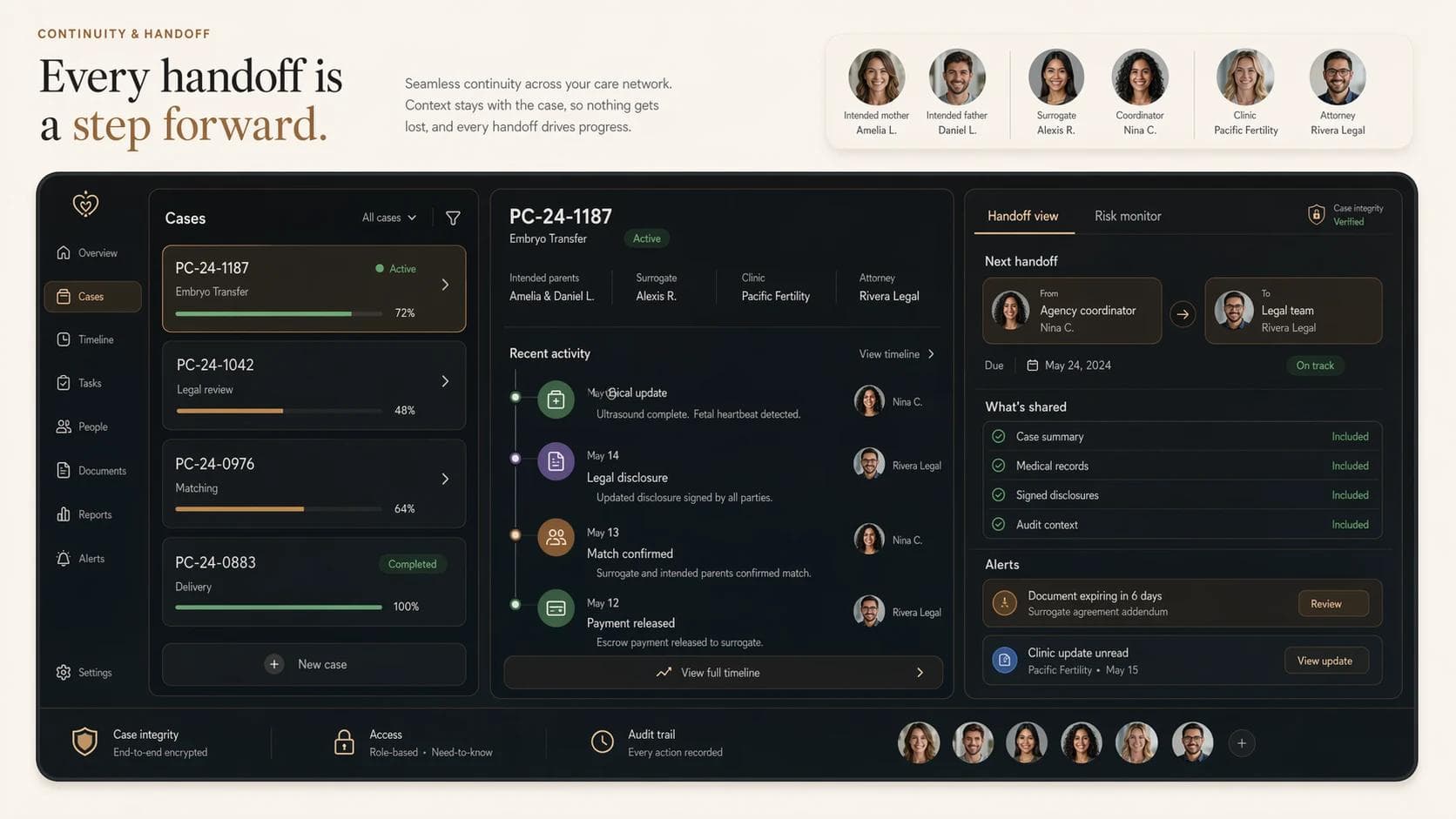
The more I build in this space, the more I believe the winning company will not look like a simple listing site. It will look like a continuity layer: a trusted operating system that carries context, consent, workflow, and case state across the full journey.
That is a different kind of company.
A marketplace helps parties find each other.
A continuity layer helps the journey survive every handoff after that.
The distinction matters because it changes what you build first.
If you think the opportunity is a marketplace, you start with profiles, search, filters, and transactions.
If you think the opportunity is continuity, you start with state.
You ask:
- What is the case token?
- What is the source of truth?
- What stage is the journey in?
- Who can see what?
- What consent is required?
- What is the next action?
- What data has already been collected?
- What can be safely handed to a partner?
- What should never leave the system?
That is where the real product lives.
I put a visual version of this thesis into the Patriot Conceptions showcase page: AI intake, matching rationale, source receipts, partner handoffs, and a continuity layer that keeps a journey legible after the first match.
At Patriot Conceptions, we have spent years building pieces of this layer: AI intake, mobile progress, admin workflows, medical records, partner access, referral loops, and case state.
The point is not to replace the humans.
The point is to stop making humans act as the only integration layer.
Great operators should not have to be the database, the router, the memory, the compliance layer, and the emotional support layer all at once.
Software should carry more of the continuity so humans can do the work only humans can do: judgment, empathy, trust, and care.
What AI should do here
This is also why AI is powerful here, but not in the way many people expect.
The opportunity is not "an AI chatbot for surrogacy."
The opportunity is using AI to make messy human inputs legible to the workflow.
- A conversation becomes structured progress.
- A PDF becomes an actionable record.
- A partner request becomes a routed task.
- A profile becomes more than a static bio.
- A case becomes an evolving state machine with human oversight.
That is the beginning of a market network.
- Identity matters.
- Trust matters.
- Workflow matters.
- Relationships matter.
- Data matters.
- The project lasts months or years.
That is very different from a simple transaction.
I believe many of the next great companies will be built in categories that outsiders dismiss as "services."
But "services" often means "complex human coordination that software has not yet made legible."
When software finally does make it legible, the category changes.
The question is not: who can build the prettiest marketplace?
The question is: who can carry trust across the journey?
That is the company I want to build.
And that is why I think the hard part is not matching.
It is continuity.
What other high-trust service market is really a continuity problem disguised as a marketplace?
Check out our showcase page: https://patriotconceptions.com/showcase
Get the next one in your inbox.
Subscribe for new issues. Unsubscribe anytime.
One email. No spam. Unsubscribe anytime.
Privacy policy